

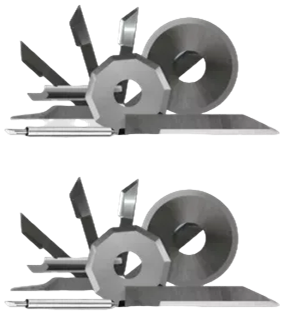
Here is a concise, practical guideline for choosing and using knife blades for Zund, Kongsberg (Esko), and Colex digital cutting systems.
1. Start with three key factors
For any of these tables, choose blades based on:
Material type (vinyl, paper, corrugated, PVC foam, rigid plastic, gasket, etc.)
Material thickness vs blade max cutting depth
Required cut quality (fine detail vs speed/throughput)
Rule of thumb: use sharper, smaller-angle blades for thin, detailed work and more robust blades for thicker or abrasive materials.
2. Zund blade guidelines
Zund uses several tool types (drag, oscillating, rotary, V‑cut, etc.).
Typical choices and logic:
Soft/thin media (paper, vinyl, film, banner): tungsten carbide drag blades like Z4 / W6 / Z1–Z3; W6 cuts up to about 2.4 mm.
Carton and light board: mid‑angle drag or oscillating blades such as Z2/Z4 types matched to the corresponding tool module.
Corrugated board/foam board: higher cut length oscillating or drag blades (Z5/Z7 or corresponding flat‑stock UCT/SCT series) for clean through‑cuts.
Rigid materials and V‑grooves: dedicated V‑cut blades (Z70 series) and rigid‑material blades.
Zund‑specific setup points:
Confirm the blade type and module in the machine interface before cutting.
Initialize Z‑axis per tool and set blade depth slightly over material thickness, not full blade length.
For high‑precision contours, pick blades with small overcut specification (for example, Z4‑type geometries).
3. Kongsberg (Esko) blade guidelines
Kongsberg tables also use drag, oscillating, and rigid‑material tools with model‑coded blades (BLD‑…).
Typical selections:
Fine detail on vinyl, pattern materials (≤3 mm): BLD‑KC104 drag blade, very fine tip but less stable.
Thin folding carton, paper, films: BLD‑SF216 (single‑edge, short cut length) as drag or oscillating for crisp edges.
Light, soft boards (corrugated plastic, PVC foam, foam banner, carpet, polyester fabric): long‑cut drag blade such as BLD‑SF246.
General corrugated/cardboard (up to around 12 mm): BLD‑SR6223 oscillating knife in 6 mm shank, tungsten carbide; good for soft and medium‑hard materials.
Rigid plastics, display carton, foamed PVC, gasket materials: asymmetric rigid‑material blades such as BLD‑DR8210A or BLD‑SR8170/8172 series in rigid‑material tools.
Setup and usage notes:
Match shank diameter (commonly 6 mm or 8 mm) to the tool holder.
Observe max cutting depth per blade (for example ~4 mm for some rigid knives, ~12 mm for BLD‑SR6223 in corrugated).
Asymmetric blades require consistent cutting direction to keep burr on one side only.
4. Colex SharpCut blade guidelines
Colex SharpCut systems ship with a triple interchangeable tool head: fixed knife, oscillating knife, and router, with optional additional tools.
Typical usage pattern:
Films, vinyl, paper, thin board: fixed or tangential knife in one of the knife positions.
Foam, corrugated plastics, gasket materials, thicker soft boards: oscillating knife for clean, low‑force cutting.
Rigid plastics, acrylic, ACM, PVC, wood composites: router with appropriate bit, not a knife blade.
Practical tips:
Let the software (Colex Cut Center) assign the correct tool per layer; confirm knife vs router in the job setup.
Use clamping bar and vacuum correctly for stable hold‑down before cutting.
5. Cross‑brand quick‑reference
|
sk / Material |
Zund example choice |
Kongsberg example choice |
Colex SharpCut approach |
Notes |
|
Selfadhesive vinyl, thin film |
Z4 / W6 drag blade in drag module |
BLDKC104 or SF216 drag knife |
Fixed knife, low depth, low pressure |
Prioritize small overcut for fine graphics. |
|
Folding carton / paperboard |
Z2/Z4 or oscillating depending on thickness |
Fixed or oscillating knife |
||
|
Corrugated board (up to ~10–12 mm) |
Z5/Z7 or corrugated blades in oscillating tool |
SR6223 oscillating knife |
Oscillating knife |
Long cut length, robust geometry. |
|
PVC foam board / foam banner |
W6 / similar carbide drag or oscillating |
Oscillating knife or router for thick boards |
||
|
Rigid plastics, acrylic, ACM |
DR8xxx rigid blades or milling tools |
Router as primary tool |
Knives only for thin sheets; otherwise route. |
6. General best practices
Across all three systems:
Use carbide blades for long life and clean cuts, but avoid hitting hard surfaces and handle carefully; they are brittle.
Set blade depth just past material thickness to reduce wear and prevent cutting into the table.
Match vacuum level to material porosity (lower for non‑porous sheets, higher for porous boards).
Regularly inspect blades and change as soon as edge quality, burring, or fibers appear; do not wait for complete failure.
Product Categories


PREV : Difference Between Ecocam E12 E18 E25 E28 E30 E50 E70 E85 E87 E92 W30 W60 Tangential Knife Blades NEXT : Comelz Cutting Knife Blades And Knives For Comelz Digital Cutter | Cutting Systems | Flatbed Cutter