

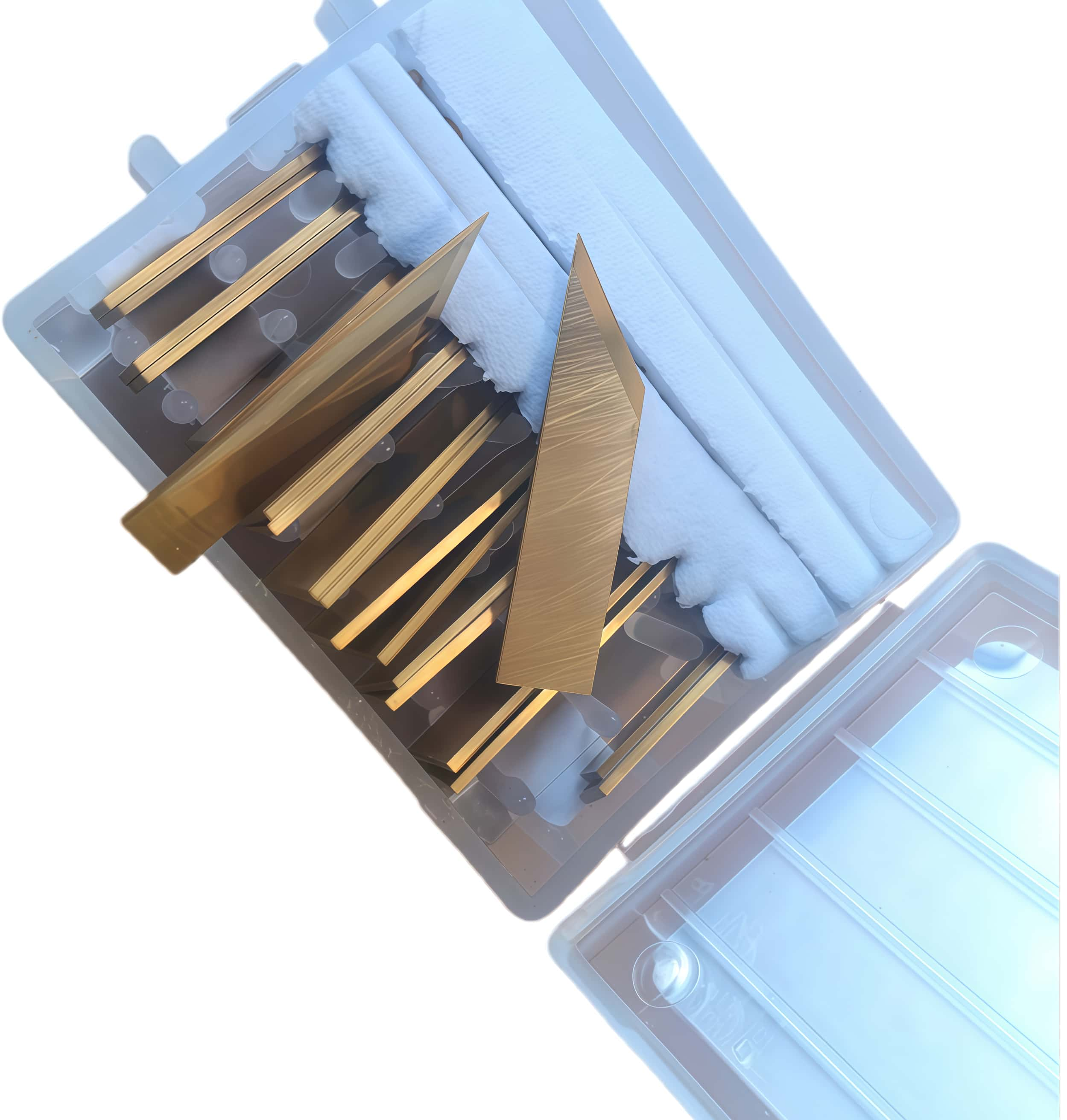
Production Process
Raw tungsten and carbon powders mix with cobalt binder, then undergo ball milling for uniformity. The mixture compacts under hydraulic pressure into a green body, followed by high-temperature sintering at 1,400-1,500°C to form dense tungsten carbide. For coatings, the sintered carbide particles bond to blade bases via brazing or thermal spraying in controlled furnaces.
Coating Application
Blades receive tungsten carbide coatings through physical vapor deposition (PVD) or chemical vapor deposition (CVD), depositing fine grit for edge sharpness. Plasma or high-velocity oxy-fuel (HVOF) spraying fuses carbide particles onto the substrate, enhancing corrosion and friction resistance. Finishing includes grinding and polishing to achieve precise geometries.
Quality Control
Dimensional checks, hardness testing (often exceeding 1,500 Vickers), and edge inspections ensure standards. Heat treatments relieve stresses, while surface analyses verify coating adhesion. Blades undergo performance trials simulating industrial use before approval


SHARE:


PREV : What impact do export controls have on China’s cemented carbide cutting tool market? NEXT : Zund CNC Cutting Knife Blade For Zund Digital Cutter Cutting Systems Flatbed Cutter