


This product reference list details the 25mm Decagonal (10-Sided) Tungsten Carbide Rotary Knife Blade, an industry-standard replacement blade used across major digital flatbed cutters and rotary tool modules.
Technical Specifications
| Parameter | Specification |
| Blade Type | Decagonal (10-Sided / 10-Faceted) Rotary Blade |
| Material | Premium Solid Tungsten Carbide / Cemented Carbide |
| Blade Diameter | 25 mm |
| Blade Thickness | 0.6 mm |
| Max Cutting Depth | ~3.5 mm |
| Primary Applications | Technical textiles, woven/knit fabrics, carbon fiber, aramid/Kevlar, canvas, and flexible sheet materials |
Cross-Brand Equivalent Part Numbers
This single blade profile is interchangeable across various CNC cutting machine tool holders (such as Driven Rotary Tools / Power Rotary Modules):This single blade profile is interchangeable across various CNC cutting machine tool holders (such as Driven Rotary Tools / Power Rotary Modules):
Zund: Z50 / 3910335
Esko Kongsberg: BLD-RC110 / G42444844
Summa: 500-0860 / 500-9860
Gerber / MCT: R50
iEcho: E50
Colex: T00360
Kuris: 83906
MultiCam: 003612-MC50
Blackman & White: BW50
Bullmer: B50
Comagrav: CD25
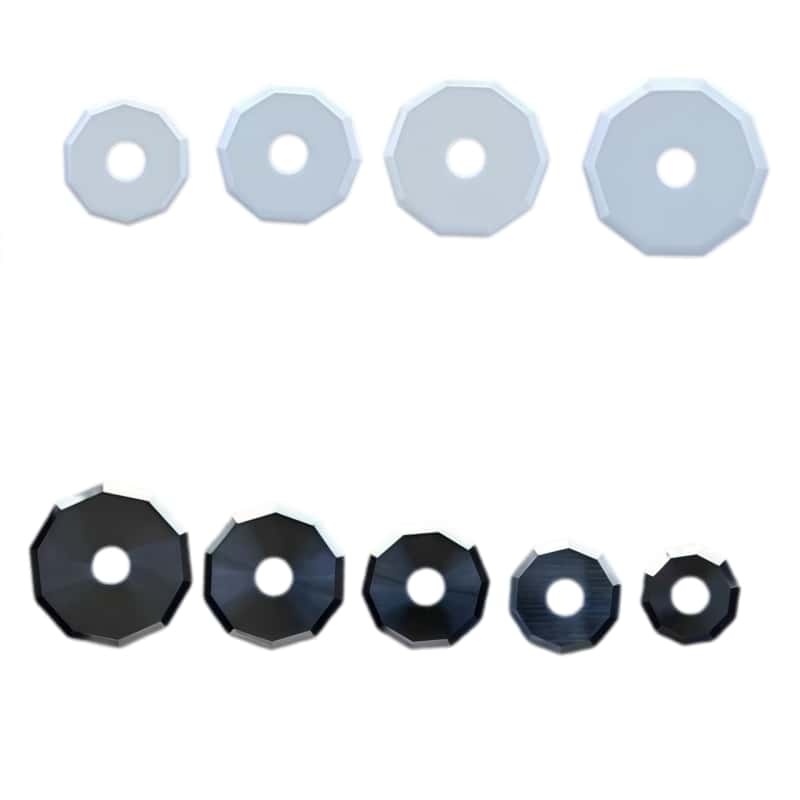
1. Determine Diameter and Maximum Cutting DepthThe physical size of the blade dictates how deep it can cut and how tightly it can turn along complex contours:25 mm Diameter Blades (e.g., Zund Z50 equivalents): Ideal for intricate details, sharp radii, and lower-profile or single-ply materials. These typically provide a maximum cutting depth of 2 mm to 3.5 mm. 32 mm Diameter Blades (e.g., Zund Z52 equivalents): Engineered for higher cutting torque and deeper penetration. These usually support cutting depths up to 7 mm, making them suitable for thicker textiles, multi-ply stacks, and dense materials.
2. Verify Machine and Tool Holder CompatibilityAlways cross-reference the blade dimensions with your specific cutting tool module. Standard industrial decagonal blades generally feature an 8 mm center bore hole and a thickness of 0.6 mm to 0.63 mm, but module compatibility varies by manufacturer:Zund: Driven Rotary Tool (DRT) or Power Rotary Tool (PRT) modules. Summa: F-Series Flatbed cutters utilizing dedicated Rotary Modules (D25 or D32 equivalents). Other Brands: iEcho, Esko Kongsberg, Gerber MCT, Atom, Bullmer, and JWEI systems.
3. Match Material Composition to Application Abrasiveness Cemented Tungsten Carbide: The preferred choice for industrial CNC operations. Micro-grain tungsten carbide provides exceptional hardness and wear resistance, which is mandatory when cutting abrasive technical fibers that dull standard steel instantly.Tungsten Steel / Alloy Alternatives: Occasionally used for general-purpose, non-abrasive soft goods where lower upfront cost is preferred over long edge retention.
4. Align with Target Cutting MaterialsTechnical & Composite Fabrics: For carbon fiber, fiberglass, aramid fiber, and Kevlar/Twaron, solid tungsten carbide is required to handle high thermal friction and fiber abrasiveness.Apparel, Felt & Soft Goods: For standard woven textiles, polyester, leather, felt, and carpet, select your blade diameter based on the compressed thickness of the material layers.


PREV : What materials are best suited for the ZUND Z17 blades? Specifications and dimensions NEXT : Tungsten Carbide Cnc Cutting Machine Knife Blades Manufacturer Wholesaler Distributor Suppliers