

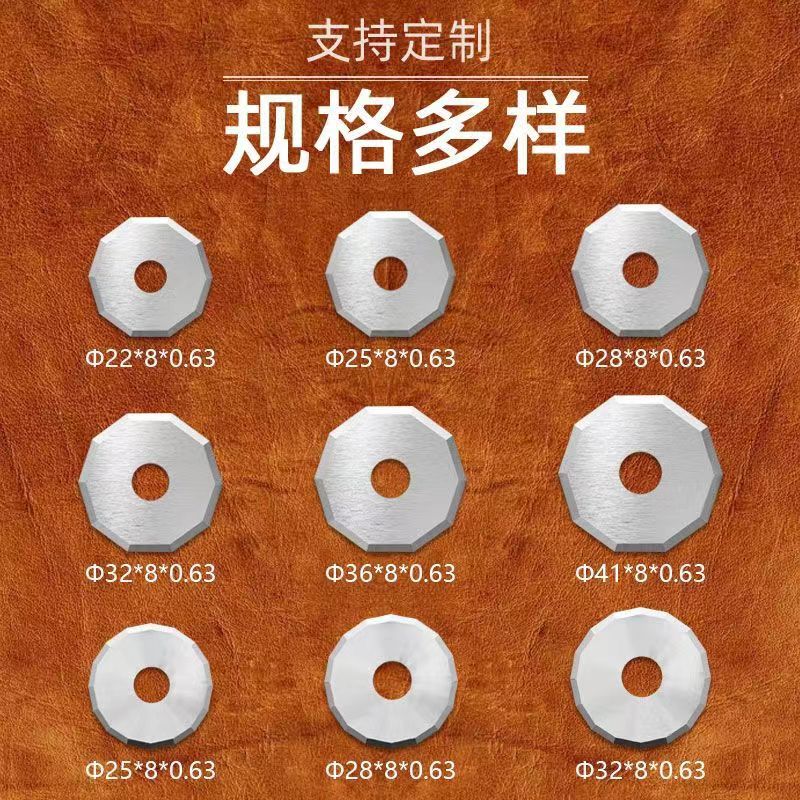
The Dynamic Cutting Mechanism of DRT/DRT2 introduces a progressive approach compared to traditional non-electric cutting tools such as "dragging knives" or "vibrating knives," which operate by leveraging repetitive high-frequency vertical chopping motions. The DRT2 (Power Rotary Tool) stands apart due to its electrically powered design featuring an independent, high-speed motor capable of operating at adjustable speeds ranging between 12,000 and 20,000 RPM. Its innovative functionality incorporates both advanced rolling shear technology and multi-faceted continuous cutting mechanisms.
The Rolling Shear system employs a motor-driven decagonal blade rotating at exceptional speeds. As the machine glides over the material, the blade effectively "cuts" through fibers using rapid rotational motion. This approach replaces the reliance on brute force exerted by traditional machines to shove or push materials apart. It represents a major advancement in precision cutting, delivering smoother and more efficient performance.
The Multi-Faceted Continuous Cutting system further enhances cutting efficiency. The ten polygonal facets of the blade, when rotating at high speed, simulate numerous minuscule scissor edges that continuously engage and shear material at an extremely high frequency. This technique provides unmatched capability in instantly severing tough, high-tensile-resistant thread ends or monofilaments without sacrificing precision.
Solid Carbide: The Material of Choice
The adoption of solid carbide for blade construction is driven by its exceptional properties aimed at ensuring durability and consistent performance. With extreme hardness and superior resistance to bending, carbide blades are precisely engineered from high-density tungsten steel or hard alloy. Rotary cutting tools often experience microscopic deformation owing to centrifugal forces generated by high-speed rotation, alongside the lateral resistance exerted by materials being processed. The use of solid carbide mitigates these challenges, ensuring that cutting tools retain their absolute perpendicularity and maintain stable cutting trajectories even when processing depths reach up to 5mm.
In addition, carbide blades possess remarkable heat resistance and the ability to prevent annealing under high temperatures. During the cutting of chemical fibers or coated surfaces, such as PVC banners, frictional heat generated by high-speed rotation can lead to edge melting or tool adhesion with conventional steel blades. Cemented carbide withstands extreme temperatures without losing cutting hardness, ensuring uninterrupted performance and clean results in demanding industrial applications.
Physical Differentiation Between DRT1, DRT2, and DRT3 Blades
Within industrial CNC systems, such as those found in MultiCam or Zund platforms, DRT tools are categorized into three primary levels based on their ability to handle varying machining thicknesses and depths of cut. These classifications are distinguished by differences in the diameter of the decagonal blade inserts used for each level:
DRT1: Optimized for small-diameter blades such as D25 (25mm), this model achieves maximum cutting depths ranging between approximately 1.5mm and 3.5mm. Its minimal overcut capability makes it ideal for intricate applications like delicate garment pattern sampling or thin nylon fabric processing.
DRT2: Featuring medium-to-large diameter blades such as D28 (28mm) or D32 (32mm), this particular model supports cutting depths typically around 3mm to 5mm. It is the most commonly employed configuration in industrial applications due to its balanced performance between cutting depth capacity and angular precision.
DRT3: Designed for maximum throughput, this model incorporates larger-diameter blades such as D50 or beyond. It is specifically geared toward processing ultra-thick materials like industrial filter fabrics, carpets, or multilayer woven textiles. The enhanced blade size ensures robust capability for heavy-duty tasks while maintaining excellent material clearance.
Overall, DRT tools showcase a dynamic blend of innovation and adaptability across their three-tier structure, ensuring optimal performance tailored to specific industrial needs.
Zund: Z50 ( 3910335 ), Z51 (3910336 ), Z52 (391033), Bullmer Premiumcut: Bullmer B50, B51, B52, iEcho: E50, E51, E52, Kuris: 84559, Atom: 01060465, Esko Kongsberg BLD-RC110 ( G42444844, 42444844 ), Summa: 500-9860, 500-9861, 500-9862, Colex: T00360, Artisto, Raptor, Gerber MCT, Lectra MFC oraz Blackman&White.
10-side blades (decagon) for CNC machines with a rotary cutting tool: Zund Bullmer iEcho Kuris Esko Kongsberg Artisto Gerber MCT Lectra MFC
Knife diameter: 25, 28 or 32 mm.
Shaft (Bore): 8 mm.
Max. cutting depth: 3,5 mm, 5 mm or 7mm.
The blade is also available in a DLC coated version for longer life!


PREV : Kompatible Cutter Messer Atom für Schneidesysteme ATOM NEXT : China Blade For Zund s3 digital cutter | Cutting System?Z10 Z11 Z20 Z28 Z46 Z61 Z70 Z71